M109
Military Truck RV Project

Below you will find
the progress of my conversion of the rear box of an M109A3 deuce
and a half truck into a fully functional rv camper.
****The
project is now complete****
The final update
was done on: April 27th, 2009.
Before anyone thinks
"oh no, here comes another slapped together military truck
camper", well you'll be happy to know that this one is
different
So my story starts
back in August of '07 with me looking for a cool deuce to drive
around and possibly do something special with. After doing a
lot of research I decided on the M109 for the wide range of
possibilities I could do with it
Fast forward to May
of '08 and I am surfing the web and find a nice M109 for sale
in PA for a reasonable price. After taking a ride down to take
a look at her in person and being happy with what I saw, I left
a deposit and drove home to make arrangement to bring her home.
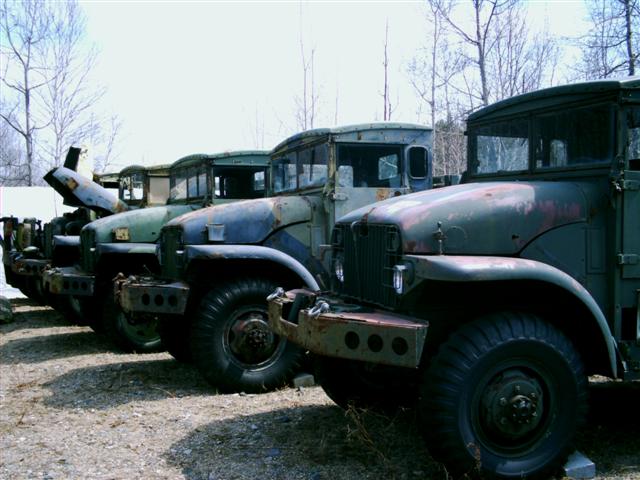
Pics of the truck
when I inspected it:


So two months later,
the trucks were paid for and transport was arranged to bring
them to the border. Once the transport arrived at the border,
we got the paperwork taken care of, then proceeded to offload
the trucks (yeah we also got a regular M35 too for the hell
of it).
The M109 had to have
the air taken out of the tires to make it legal on the trailer
for transport. We also learned that the truck batteries were
now dead on the M109 and would need a jump start to get going.
This was weird as the truck started up perfectly when we had
inspected it two months ago. Oh well, we pushed it off the trailer,
and after getting the M35 off, we used some jumper cables and
started the M109 by boosting it using the M35.
So we are now on
the road home and everything is going well......until the voltage
gauge in the dash of the M109 goes from 28v to 16-18v 20 minutes
later. Then it drops to 0v a few minutes later. Luckily, the
truck doesn't need batteries once it is running to keep it going,
so we press on home. We were also lucky that we had someone
in a pickup truck keeping close behind the M109 as the brake
lights and turn signals were very very weak and hard to see.
Got home safe and
sound 3.5 hours later. Happy and relieved it went well.
Later on I found
out that the generator/alternator had blown on the ride home.
It also killed both batteries at the same time. It cost $500
to get the generator rebuilt, plus another $200 for two brand
new heavy duty truck batteries. Oh well, that's a 38 year old
truck for ya.


Now we fast forward
a couple more months. I am super busy during the summer months
with work, so I didn't have any real time to work on the truck
except for looking on the internet here and there for design
ideas, parts, and trying to figure out a budget. I also had
to bring the truck for a safety inspection before I could be
allowed to drive it on the road.
Near the end of summer,
I finally got around working on the truck so that I could bring
it to get inspected. I didn't have anything super difficult
to do to the truck, but it was still labor intensive. A few
things that were mandatory are the installation of marker lights
all over the truck, license plate light, longer rear mud flaps,
and a few other little things. Though even after all that work,
the guy at the inspection center still found things for me to
fix. First of all, he wanted me to fix the lights so that they
come on when the truck is in reverse. I had to explain to him
several times that the truck didn't come with that feature,
and it wasn't until the old timer who worked there came out
and told the guy that it was true, that we moved on to the rest
of the inspection. After an hour, the guy told me that he found
2 things for me to fix. One was a break line that was rubbing
against the frame, and the other was that the bushings on both
front shocks where finished. The next day I was back with the
truck and the two little things fixed and I had my "certificate
of conformity", and was now allowed to drive the truck
on the road legally.
It was now the time
for designing of the RV portion of the truck. I didn't just
want to stick a couple of beds in the back and call it an RV.
I wanted to outfit the truck will all the luxuries of a regular
RV, while also keeping the exterior as stock as possible.
After sitting countless
hours in the back of the truck measuring and thinking of how
I am going to make things fit, I finally came up with a basic
design that I have stuck with through the entire process.

First thing I needed
to do was to repaint the interior though. The old lime green
wasn't up to my tastes, and had seen better days. So I bought
a gallon of grey metal paint and went to work with the paint
gun. It really freshened things up.
After a few days,
the paint was completely dry and I could work in the back of
the truck again. So I got to work on the floor. The original
wood plank floor, like the paint on the walls, had seen better
days. I decided the best thing to do was to get a few sheets
of 1/4" plywood to cover it up to give me a better surface
to work and live on.
Took 3 sheets, 200
deck screws, and 6 tubes of construction adhesive. But I now
had a nice clean floor to work with. Then came a couple packs
of self adhesive vinyl floor tiles. I love these tiles, as they
are easy to install, durable, and cheap. And if you have an
accident and damage one of the tiles, just rip it up and stick
down another one. Looks pretty good I think, and is very easy
to keep clean.


First thing I bought
to go into the back of the truck was a bunk bed. I thought about
making my own, but after looking at how much time it was going
to take me, and the cost of the metal, it was a lot cheaper
just to buy one ready made.
Off to Ikea, and
for $200 I got a bunk bed that fits perfectly in the truck,
and even matches the color of the walls. lol.
Even though it may
not look it, there is more than enough room on the top bunk
to sleep comfortably up there.
The only modification
I had to make for the bed was that I ripped off the side rail
on the top bunk to make it easier to get up there.


Next step was to
work on the kitchen part of the truck.
After looking for
a while on the internet, I found a nice sink/burner combo unit
that not only gives me both a sink and burner top in one package,
but also leaves me space for other things
I then went to the
local kitchen supply store and picked up a nice aluminum table
unit to mount the sink/burner into. It is 5ft by 2ft, which
was a perfect size for the truck. After taking a few measurements,
I cut out a hole for the sink/burner unit, and mounted it in
place.


Now that the kitchen
unit was taking shape, I went on the look out for a nice small
fridge to put in the truck. I found this nice little fridge
on ebay for a good price. It came out of a freightliner tractor-trailer
truck. It runs off 12v AND 24v. I really like the option to
run the fridge off truck power if needed, as I can keep the
beer cold while the truck is driving down the road :)
It also found that
it fits perfectly on the bottom shelf of the kitchen unit. I
was going to make a cabinet to install a fridge into beside
the kitchen table, but at the last moment, I saw that it would
work much better on the bottom shelf.


After a while I finally
got around to installing something to replace the original military
power connector on the truck. I looked on the internet for a
bit trying to find the original connector that fit into the
side of the truck, but after finding out how much they cost,
and saw how much hassle it would be to climb up on the side
of the truck each time to connect it, I decided to install my
own.
After a trip to the
RV store, I returned with a standard RV connector port and cable
which would let me connect up to power at any RV camping spot,
as well as picking up a standard reverse outlet to connect up
a regular extension cord if I didn't have an RV power port to
connect to.
Drilled some holes,
ran some wires from the outlets up to my electrical panel and
I was done. I now had power in the back of the truck for lights
and outlets.


With a sink, you
need water. And while cold water is nice, I wanted to have some
sort of hot water for washing and cooking. I found a nice tankless
water heater for sale on ebay which you can mount inside, runs
off propane and 2 d-cell batteries. This little until will heat
enough water for 28 hours of continuous use on one standard
BBQ propane tank. Now on a standard camping trip, I doubt I
would use more than 2-3 hours max of hot water use. That means
one BBQ tank could easily last me more than a year.
I also ran all the
water piping from the water heater to the sink, future shower,
toilet and all the way to the water tanks which will be located
under the bed.


With all the work
I had been doing in the back of the truck, I thought that it
would be a good idea to find something to lock up the back of
the truck to keep sticky fingers out. The truck came with the
standard pad-lock hasp, but I didn't like that, as it was also
a good way for someone to lock you inside.
I picked up a flush
mount dead-bolt lock at the local hardware store. After some
drilling and cutting I managed to get it installed. No way you
are getting in without ripping the doors off.


With all that work
done, I decided to work on some electric stuff.
I got out some spools
of wire, some switches and a set of wire strippers and got to
work. First I ran wires to supply power to the fridge. The wires
go from the fridge into a box which allows me to do a few things.
By flipping the switch up, I can run the fridge off truck power
(for when I am driving to keep things cold). By flipping the
switch down, it turns on a 120v-12v converter to run off main
power (for when I am parked, camping). I also installed a switch
and ran some wiring to control a 24v-12v converter to supply
power to the accessories in the back if I am parked where I
cannot plug into shore power. Lastly, I ran wiring and a switch
for controlling power to the water pump for the sink/shower/etc.


Now that the wiring
was pretty much wrapped up, I worked on the water inlet for
the truck. Like a regular RV, I want to be able to either run
off the water stored in my water tanks, or off a standard hose.
To do this, I picked up a water connection port to mount on
the side of the truck.
After figuring out
a good place to put it, I took some measurements and cut a hole.
Once I checked that everything was good, I got out some spray
paint to change it from the ugly white, to something a little
more discrete. It will blend in better later on when I repaint
the entire exterior of the truck.


A water inlet port
is all good if you are just running off a hose, but if you are
out camping in the woods, you need water tanks to hold the water.
After looking around a bit, I found the best solution was two
21 gallon potable water tanks, which gives me 42 gallons in
total. And yes, before anyone says it, I know I can get a 42
gallon tank, but it wouldn't fit under the bed. I only have
9 inches of space under the bed, and the 21 gallons tanks are
the only ones that fit (they are only 8 inches tall) :)
Once my tanks arrived
in the mail, it was time to mount them. I started by putting
down a piece of foam so that they wouldn't sit directly on the
floor and get damaged when driving down those bumpy roads. I
then proceeded to cut and shape a strap to fit over the top
of the two tanks to keep them in place. Then I cut two L shaped
pieces of metal to sit at both ends of the tanks to keep them
from sliding out from under the strap. Now it was just a simple
matter of painting the pieces and then screwing them into place.
I will link the two
tanks together later on so that they will get filled up at the
same time, and that the water pump will pull equal amount of
water out of both tanks when using water for the sink/shower/etc.


Now that leads me
to the shower/toilet unit.
After looking high
and low for a reasonably priced combo unit, and coming up empty,
I decided to make my own. I bought a shower pan at the local
hardware store, and got a hold of an industrial use mini flush
toilet.
I am currently working
on the walls for the shower and finishing up the plumbing for
the water, but I hope to have it finished in a couple of weeks.
This is what it looks
like quickly with just the two units sitting there.

Installation of heater
pads on the oil pan to keep the oil warm during the cold months.
As well as a heater blanket for the batteries.


Here are some other
mods I have done to the truck. Thought I would mention them
as well since I was already uploading some pictures.
-Installed a coolant
filter.
-Battery kill switch.
-Muffler.
-Muffler clapper to keep rain and snow out so it doesn't rust
out the bottom of the J-pipe (again).
-And the most important mod ever......a cup holder


Picture as of Jan
19th. 2009. Still stock on the outside, which is the main plan.
Starts up in -30F with no problems.

I have done some
more work on the shower/toilet area.
The first thing I
did was to remove the exhaust fan and plug up the hole. In the
beginning, I had planned to keep the fan to help exhaust the
steam from the shower, but now that I am at the stage of installing
the shower, I see it is just too impractical. Not only does
it take up a lot of room, but it would also be in the way of
the shower controls and shower head. So out it came. I blocked
up the hole on the outside, as well as on the inside. I made
sure to seal it up good with some exterior sealant, and filled
the cavity with some insulating foam.
The fan still works
great, so I will very likely install it somewhere else in the
truck later on.


For the shower, I
naturally cannot just put the floor pan in place and use the
shower as it sits there, as the water from the shower would
get all over the place, including inside the walls, causing
everything to rust. But I couldn't also just screw the shower
wall material to the current walls, as they are covered in screws
and bolts, making a very un-uniform surface. So the only thing
I could do was to make a skeleton wall so that I would have
a flat surface to apply to shower walls to. The cheap and fast
way of doing it, would have been just to get some thin wood
planks and frame it that way. But I want to keep as much wood
out of the truck as possible (especially in a humid place like
a washroom) so that I don't get any wood rot in the future,
as well as any place for mold to grow on. So I went to the metal
place this week and picked up some 3/4 inch metal tubing. With
that, I cut the pieces of metal up and welded them to the inside
walls of the truck.
Then I primed the
metal to stop it from rusting. I will paint it gray like the
rest of the inside of the truck next time I work on it.


I also got around
to fixing up something for the shower controls. I needed something
that sat on the outside of the wall instead of the inside of
the wall like in a standard home. This was due to the fact that
I don't have any space inside walls to install the controls
inside of.
I found a set of
controls for a washing machine. It will let me mount the plumbing
on the outside of the wall and has a nice plastic cover to hide
everything once I have it installed. The shower cable will come
out the bottom of the cover. I had to get some adapters to fit
my water system, but it is all ready to go now.

I was driving by
the kitchen equipment store last week, so I decided to go look
at finding something for a desk.
After looking for
a while, I decided that the best thing to get was the same style
table I am using for the kitchen station. All aluminum, so no
rust, and is adjustable in height. I got one for $200, which
is pretty darn cheap, as you can't even build your own for that
price! The white plastic on the top of the table is just there
to keep the top from getting scratched in transport.
And as you can see,
I still have space between the two tables to add a cabinet for
storage.
Yeah I know, things
look a little bare in the truck. But that's because it is still
a work in progress and is missing all the accessories :)
I will be posting
some more progress this week. I got my water pump and water
tank connections in the mail today, so I can finally connect
up the water system and check it for leaks. I will also see
about firing up the water heater and seeing how she works.


So on to today's
work.
I had been waiting
for a few orders to arrive, and luckily on Friday I got my 24v-12v
power inverters. I have one installed in the back of the truck
to power the accessories there, but I also wanted one for the
cab of the truck to power a few things there. I bought a few
spare for the other trucks we have in case we want to do the
same thing to those trucks.
I started off by
deciding where I wanted to put the outlets in the dash and I
found the best location was to the right of the instrument cluster.
Then came a few holes.
Four holes to be exact. One for each outlet, one for a switch,
and lastly one hole for an LED light to tell me it's on.
After all the holes
were made, I could move onto the electronics portion of the
install. I started by getting a 24v-12v inverter and connecting
a fuse and switch to it. I also removed the little LED that
was installed in the inverter, connect up some wires to where
it was connected, and ran an external LED so that I could mount
it on the dash. Once I had that all finished, it was a simple
process of screwing the inverter to the underside of the dash
and mounting the outlets, switch and LED. Sorry but I forgot
to take pictures of the inverter and wiring, but don't think
you've all seen a bunch of wires before
Looks pretty good
I think and will come in handy for those long trips.


Started off today
by working on the water system on the truck. I got all the hoses
and fittings this week, so I decided I might as well tackle
it.
Got it pretty much
all hooked up. Only have two hoses to finish connecting, but
I ran out of connectors and didn't feel like going out on Sunday
afternoon to the store in town to buy some more. I will pick
some up tomorrow. Once that is done, I will just have to connect
the wiring to power the water pump and I will be pretty much
finished and ready to run some water.
I also got around
to installing the cab heater manifold. In my truck, the military
never got around to installing the manifold and ducting so that
I can defrost the windshield properly. So the only way I could
defrost the windshield in the winter was to have the truck running
with the heater at full blast for 30-45mins which would eventually
heat up the entire cab. This is not too much fun if you want
to get going fast. Last week I went to a military surplus and
pulled off a heater manifold off of a scrapped truck for $30.
It came out of an MLVW (Canadian version of the US M35), but
it is the same type used in the US version.
Marked the mounted
brackets and drilled some holes. Then I bolted the manifold
in place and ran the ducting. After the ducting was in place,
I installed the control panel for the heater and gave everything
a little paint. Looks like it was always there.


It was way too cold
to work outside today (-28F) so I decided to work on the M109
instead.
Got to work on finishing
the water system. I had to stop yesterday because of a lack
of connectors, but after a quick run to the store today, I was
now all set to finish it up.
The following pictures
don't look too different from the last ones I posted, but it
does show that everything is all connected now. I also took
some close up pictures of some extras I installed into the system.
On the output side of the pump, I installed a flow control valve.
This is very important if you also have a connection for a regular
garden hose on the side of the truck for running on an external
water supply. Because if you don't install this control valve,
the water from the hose will push through the pump and fill
up the water tanks which will eventually overflow. The control
valve only lets water flow in one direction. I could have just
installed a regular valve to close when I am on external water,
but this way I cannot forget to shut it off.
Installed just before
the pump, I also made sure to add a small water filter. This
is another important feature, as without it, your pump will
get clogged over time from sand and other fine material that
gets into the water tanks. This one is very easy to clean, you
just unscrew the bottom cap, take out the little metal screen,
clean it out with a rag, then pop it back in. The cap that holds
the little screen is clear so that you can see if it needs cleaning.
One more thing I
installed was an extra connection point for the water system
before the pump. At the moment I just capped the pipe, but next
time I go to the store, I am going to pickup a spare air connection
and valve so that I can connect up an air hose to the water
system. This will let me flush out the water in the piping in
the colder months so that the water doesn't freeze and crack
my water piping in the truck. I installed it before the pump
so that it will also push any water out of the pump so that
no water will freeze and cause damage inside of it.
Once all the piping
was finished, I got around to finishing up the wiring. I connected
the wiring to the pump, added a in-line fuse just to play things
safe, then ran the wiring into the control box. Just like the
switch for my fridge, I can either run my pump off shore power
through the 120v-12v converter, or truck power through the 24v-12v
converter.
Now that the wiring
and piping was all finished, it was time to test the system.
I connected up a water hose and filled the water tanks about
half way. Then I turned on the pump to see if I could send water
throughout the system and that there was no water leaks. Success!
No leaks and the water flows great to the sink. Then I decided
to try out the external water connection. I connected the hose
to the external water connection outlet, opened the valve and
success again! Water flowed great to the sink and no leaks what-so-ever!
I am very happy to
be pretty much finished the water system in the truck. The only
two things I have left to do are to connect the shower controls
and try out the hot water heater. I was going to try the water
heater today but realized that I didn't have any propane to
test it with. Hopefully I will find a tank to try it with sometime
this week.


I also got the camera
for my truck today. I will mount it on the rear of the truck
to help me when backing-up the truck and monitor anything I
might be towing. I will also use it to see who is at the back
door when I am inside the truck. Nothing special, but cool non-the-less.

More work was done
this afternoon when I had some free time.
After putting the
truck in the garage, and taking a lot of measurements, I decided
that I would install the two side-by-side lockers into the truck.
These lockers not only fit the best, but I believe they will
work the best for me.
One problem I had
was that the lockers were a little too wide to fit between the
kitchen table and the desk. So I ended up taking a few inches
out of one end of the desk so that they would fit. Nothing super
difficult. I didn't bother taking any pictures of the desk getting
cut up as I didn't see any point.
Once I finished cutting
the desk to size, I put it back into place then lugged the lockers
into the truck. They fit "just" between the two, which
is the way I planned it as I didn't want any lost space between
any of the units for stuff to fall between.
I think it looks
great and it gives me a good amount of storage.
The only little problem
I noticed once I installed the lockers was that I was blocking
one of the outlets on the wall. I have a ton of outlets on the
wall, so blocking one wasn't going to leave me outlet-less (lol,
if that is a word), but I thought it would be a good idea to
have access to it anyway. So I got out the hole saw and cut
a hole into the back of the locker which now gives me access
to the outlet. I could use it to charge something like a MP3
player, cell phone or laptop while keeping it secure in the
locker.


Next I got to looking
for a space to install another small cabinet that I bought.
I had thought about hanging it on the wall, but the more I looked
at it sitting there, the less room I seemed to now have. So
in the end, instead of mounting it on the wall, I decided to
install it under the desk. That way I still get the storage
I need, while leaving me the space above the desk.
It is a nice lockable
metal cabinet which I can put a good amount of stuff inside
of.
Lastly, I bought
a nice little microwave today. I was at the store to buy a movie
when I noticed that they had some microwaves for sale. I found
this one which I think will work great in the truck. It is the
smallest in size that I have seen anywhere around here, and
the wattage is also good for the truck at only 700watts. I didn't
want anything any higher in case I have to run the microwave
off a generator. It only cost $50, which is pretty cheap I think.
I am not sure where
I will mount it at the moment. I am looking at possibly under
the sink area as it would keep it off the table so that I will
have more place to work, but I have not decided yet.
That's all for today.
Until tomorrow


I started off the
day by working on the microwave. After thinking more about it
last night, I decided that the best place to put the microwave
was to mount it up on the wall. This will leave me space on
and under the counter for other stuff.
I first went to the
hardware store and bought some mounting brackets and stove bolts
for the setup. Then I put some holes through the side of the
truck and ran the bolts through.


Then the brackets
were bolted to the wall.

Next I added another bracket to the side of the lockers to give
me added support. I also added a metal plate on the inside of
the locker as the walls of the locker are not very thick.


Now comes the shelf.

To secure the shelf
to the mounts, I counter-sunk some more bolts. This is much
stronger than just putting some screws through the bottom. Which
is important when the truck is bouncing down the road.


I was now ready for
the microwave. It fits perfectly on the shelf. I made the shelf
6 inches longer so that I can mount some little containers on
it to hold things like spices.


The only thing I have left to do is to install the brackets
that hold the microwave to the shelf. I was going to do it today,
but I just seemed to run out of steam after a while and decided
to just leave it rather than screw up something because I didn't
feel like working anymore.
I did a little bit
of more work on the truck today.
I finally got around
to getting a blocker heater for the engine. I have been looking
around for 3-4 months for the proper blocker heater for the
truck as the military never installed one for various reasons.
I was able to locate one at NAPA which fits in the 2" freeze
plug hole on the side of the engine. It is not as powerful as
I would like for a big engine (only 600watts). I was told that
to be really effective I should install two of them. But after
thinking about it for a while, I decided that one will be more
than sufficient. If I needed to start up the truck within say
1-2 hours, then it would be worth installing both of them. But
I plan on leaving the truck plugged in overnight if I need it
the next morning, which will give it more than enough time to
warm up. Though technically if I plug it in for 3-4 hours, it
should be good enough to help. I already have the oil pan heaters
which make a HUGE difference on the truck when starting in -20F
and below temperatures. The block heater will just give me that
little bit more to help start it up.
The first thing was
to locate a freeze plug to pop out. The only one which I could
easily get to was on the passenger side of the truck near the
middle of the engine. The only other plug is near the back the
engine near the cab on the same side, and I would have had to
remove the air cleaner to reach it which I didn't feel like
doing. I started by dumping the coolant out of the engine and
then taking off the pipe that runs from the air cleaner to the
turbo. I used some clean rags to plug the holes to make sure
no shit gets in the turbo (which would be a bad thing if it
happened). Now the engine was ready for surgery and I had better
access to the freeze plug.
Then came the "simple"
task of popping the freeze plug out.
I was told that it
would just take a few hits with a hammer and punch to get it
out. Well that is all nice and good for a car/truck a few years
old, but not a 38 year old truck. The engine was rebuilt by
the military back in 85, where they likely replaced all the
freeze plugs, but that was still 24 years ago!
So after 20 minutes
I finally got luckily and the freeze plug starting to pop free.
I had to drill a few holes in the plug and use the punch to
bend it inwards somewhat. Then after a few more hits from the
hammer and punch, it came free.
One thing I was always
told was to be very careful not to send the plug into the engine.
Sending the plug into the engine could cause an outlet or inlet
port to get blocked and the engine to blow. Plus the only way
to get the plug out most of the time is to rip the engine out
of the truck and take it apart. That is not something I wanted
to do. So to be sure that didn't happen, I got some metal wire
and ran it through the holes I punched into plug and tied it
to the oil stick tube which was located just outside the plug
hole. This way, if I accidentally hit the plug too hard and
sent it into the engine, I could just pull on the wire and pull
it out. Luckily I didn't have to use it, but I didn't want to
take a chance. You can see the wire in the picture below.
And now the plug
is completely out.

Then it was just
a simply task of putting in the block heater in the hole and
turning the screw to tighten it into place.

Now I connected the
plug, and put the pipe back on the turbo.


With all that done
I proceeded to dump all 6 gallons of coolant back into the engine.
Once it was all back in, I waited 10 minutes and checked the
plug for any leaks. There were none, so on to the next step.
After checking the coolant level again, I got in the truck and
started it up. I let it run for 10-12 minutes and watched the
plug for any leaks. None what-so-ever. Success!
Yeah I know most
of you are saying "man this guy has problems if he gets
happy installing a blocker heater". Probably true, but
I am happy non the less. It was the first time I had installed
one and had been wanting to install one on the truck for a while
now. This way the truck will be able to start even in the lowest
of temperatures.
I was looking at
the little 1200watt generator I got a while ago, and I think
I might go and get something bigger for several reasons. One
reason is that I may need to start my truck in very low temperatures
when it is sitting far from any electrical outlet. Or in the
case of camping in the woods, no place to plug her in anywhere.
The little 1200watt generator is not strong enough to power
the oil pan heaters, block heater and battery warmers. A more
powerful generator in the range of 4500-6500watts could without
a problem. I would also like to be able to power the entire
truck system and any exterior systems if needed. This would
include having all the lights on the inside and outside of the
truck, security system (cameras, monitors, PA system), kitchen
(microwave, vents), water system (shower, sink, pumps), computer
(laptop), battery chargers (for things like radios), and maybe
lighting and heating in tents/structures near by. Naturally
all of these things would not be turned on at the same time,
though even if they were the generator could probably take it
because many of the uses are low power.
At a local farm supply
store they are selling 6500watt diesel powered generators which
I think would work well with the truck. I am planning to install
super-single tires in the spring, but after taking some measurements,
I found that the new tires will not fit in the spare tire bracket
(it is made for the original, smaller Non-Directional Tires).
So in its place, I would install a box for a generator to be
mounted inside of. And by getting a diesel generator, I could
run a line into the truck's fuel tank, giving me a hell of a
lot of fuel to run off of if needed.
I found a picture
of someone who did something similar on his truck:


I had an hour or
so late this afternoon, so I decided to do a little more work
on the truck.
Installed the extra
lock on the future gun locker:
Installed the mounting
feet on the microwave to keep it in place:

Then I proceeded
to work on the exterior lights. I tried to figure out a place
to mount them properly so that they will shed a good amount
of light around the truck and decided that the best place was
directly on the corner lift brackets.

After a little grinding
and welding, I had the brackets installed. This is a picture
before I grinded down the welds and painted it.


The light looks like
it will work great.


So I installed them
on all four corners.


I just have to wire
them up to power and some switches and I will be all set. I
will be very interested to see how it looks when lit up at night.
I have plans to install
a metal basket above the cab to hold extra gear. Just like one
of my other trucks:
Once that is installed, I will be able to mount four lights
to the front of the truck for extra light when driving at night.
Because without the lights above the cab, it will be hard to
see at night with the front of the truck covered in zombie guts
when driving around in the end of the world. lol
I pretty much finished
up all the wiring for the spot lights today. So I went back
to the shop a little while ago to try and take some pictures
of the spot lights working at night.
Pictures didn't turn
out that great, but it's the best I could do.
They light up around
the truck pretty well. I just have to adjust them so that they
point down closer to the truck a bit.
I decided to do a
little work on the truck today. Nothing exactly difficult or
major.
I am going to change
all the tires on the truck to super singles. This will replace
the 10 tires with 6 "super single" Michelins. It will
not only give me better milage, but less wear on the truck drive-train
and much, MUCH, better traction than the standard NDT's (Non-Directional
Tires) that came with the truck.
Though at the moment,
I only have 2 of the new tires as I am still saving up for the
other 4. They are not very expensive. Well they are actually
pretty damn cheap from the surplus store I am buying them from
at $275 for the tire AND rim (the tires are all at 90-95%).
But it is still a lot of money when you add it all together
($1650+tax).
Some pictures of
the originals on the truck:
Old and new tires
side by side:
New tires installed:
I picked up some
parts for the truck so that I can work on it this weekend.
I started out by
buying two roof vent units. I wanted them with a black-tint
cover, but the black ones were $15 more for some stupid reason,
so I got some brownish colored ones instead. I wanted one of
them to be a fan powered unit, but at $400 (compared to $60
for a standard unit), there was no way I was going to pay that
price. But what was real stupid is that you can buy an "upgrade
kit" for a standard vent unit that will add a fan and switch
for $30. I will see how these two work, and if I find that I
really need a fan, I will spend the extra $30 for the upgrade
kit.
These vents will
help keep the back of the truck cool, and will help vent out
smoke/fumes from cooking and the steam from the shower. They
will also let in more light so that I don't have to turn on
the lights as much.
I picked up some
puddy-sealant to put under the vent when installing it on the
roof, as well a can of liquid sealant to put over the top of
the lip to make it really waterproof. I will also use the liquid
sealant to waterproof a few little holes I have in the roof.
While I was there,
I found two nice little fans for sale. They run off of 12volts,
have a high/low setting and can either be held in place with
a clamp or some screws. They were only $11.50 each, which I
found was a bargain.
To help get me started
for tomorrow, I took the vents apart and painted them a bit.
The top of the vents were just bare stainless steel metal so
I painted them black so that it would blend into the truck better
and not be reflective when the sun hits it. I also painted the
interior bezel grey so that it matches the inside of the truck.
Tomorrow I will cut
some holes in the roof and install the vents.
I got to work installing
the roof vents today.
I started out by
taking some measurements and finding the proper spot to mount
the first vent. Ideally, I wanted to mount it in the center
of the truck, but there is a roof support bar in the way, so
I placed it off to one side. Though it will still work just
as well.
Then I started cutting.
Once I had the opening,
I found that the wiring for the nearby light ran right through
the middle of my hole.
It was simple enough
to fix though. I just cut the wires, attached some longer wires,
then ran the wires around the hole.
Now that were out
of the way, I was able to finish cutting the hole.
Then I put the top
part of the vent in place with the puddy and lots of screws.
I also used the can of sealant, but forgot to take a picture
of it.
And then the bottom
part was installed.
All installed.
Due to some other
stuff I didn't have time to install the second unit. It will
wait till next week.
I did some work on
the truck today. It was real nice outside today, so I threw
outside one of the service trucks and brought in the truck to
do some work. I also need the truck to sit inside tonight so
that it is dry and warm for some important work I have planned
for tomorrow.
Last weekend I was
at a closeout store and found a nice LCD wall mount for only
$40. At places like BestBuy, they ask ridiculous prices for
their mounts, so I got this one instead for less than a quarter
of the price. It pivots in all angles and seems to be very well
made. I got it cheap because the original packaging was damaged
and they just put it in a plan white box with no graphics or
pictures on it.
I first had to make
a trip to the hardware store to get some bolts to install it
on the wall. It came with a set of bolts for screwing the unit
into the wood frame of a wall, not a metal one. Once I had the
bolts I found a good spot where I could see the TV from sitting
at the desk or laying in one of the beds. Then came some holes
and the bolts which I ran right through the side of the truck.
Then I put the arm
in place.
I will take a picture
of the LCD TV installed tomorrow. I will be using it to watch
TV, movies and the security cameras I will be mounting around
the truck.
Oh ya and a lot of
porn, but I am sure you already knew that.
After that little
job was finished, I got around to finding a place to mount the
second roof vent.
I first thought about
mounting it above the beds, but then decided against it for
two reasons. First, I don't like light in my face in the morning
when I am trying to sleep. And also in case, for some reason,
the vent gets a leak, I would rather it leaked on the floor
then on my bed.
Then I thought about
installing it near the very front of the truck, but decided
against it as well because I plan on installing a hatch to the
roof in the same location one day, and I would just end up moving
the vent again when I got around to installing the hatch.
I ended up installing
the vent in at the end of the desk. This will give me light
so that I can work at the desk without having to use a lamp.
As well as ventilation to let out all the hot air from my head
when I am thinking.
I didn't bother to
take pictures of the vent installation as it went the same way
as the first. I thought that just the finished pictures of the
install would suffice.
Got up early this
morning and decided to head off to the shop to get started asap.
As you may or may-not
already know, the truck is a 1970. Meaning, as of this year
it is 39 years old. And anyone that is around that age knows
that things don't work as well as they use to and that parts
start to deteriorate ;)
In the case of the
truck, it has a few rust issues. A little bit of through rust
on the front fenders, one or two on the camper box, and lastly
a "few" in the roof of the box. I knew about the rust
on the fenders and the sides of the box even before I bought
it as it was very easy to see and expected for the age of the
truck. But when I first inspected the truck I never got around
to looking at the roof of the box. From the ground I could see
what looked like surface rust on the edges and thought it was
probably the same on the top of the truck, just surface rust.
Though once I got
it home and actually started working on it, I found out there
was a little more than surface rust on the roof:
Yup that was one
of 3 large holes in the roof. When it rained, the water would
get in and pour out from the inside walls. This is not something
a feature I was looking for in a camper truck. I stopped most
of the water from getting in by filling the holes with exterior
caulking. While this stopped the majority of the water, some
of it was still getting in. So I riveted some metal plates over
the holes which worked well for rain. But when I got snow on
top of the truck, the snow would hold the water in place and
push it into the very small gaps in the metal, letting it into
the truck.
Enough was enough,
so I went to the automotive store and bought a can of this stuff:
It is a spray/roll
on truck bed liner. Very easy to use, just pour it in a undercoating
gun and spray it on, or just roll it on with a standard paint
roller. I decided to do the latter so that I could put it on
thick and not make as big of a mess as if I had sprayed it on.
If applying to a
smooth surface, like a clear-coated truck, you need to sand
down the paint to give it a good surface to adhere to. But since
my truck is painted in flat paint, I didn't have to sand it
down really. I did scrap off some loose paint and rust though
before applying it to the roof.
When I got up to
inspect the truck this morning, I noticed that I had a wet spot
on the roof. The roof of the shop leaks in 2-3 places (very
small leaks) and I just happened to park the truck under one
of them. The truck had been parked there since yesterday afternoon,
so the small leak had caused a big wet spot.
So after moving the truck into the other bay and drying off
the roof with rags and an air gun, I was ready to coat the roof.
I made sure to give
it a good thick coat and to really push it into any places where
the roof had rusted and the joints between the metal sheets.
I also made sure to coat the edges of the roof by the gutters
where water collects and could possibly rust through.
I intentionally made
sure to install the roof vents before apply the liner so that
I could seal the vents to the roof and not have a chance of
water getting in around the vent areas.
Another nice thing
about this bed liner is that it is paintable. So once you have
applied it, and given it at least 24hours to dry, you can take
pretty much any paint and paint color to blend it back into
the vehicle. Most people leave the liner black as it won't show
most messes they might make in the bed of the truck, but some
people do go and paint it.
I will be leaving
the roof black at the moment, but I will end up painting it
green when I repaint the entire truck in the spring.
I didn't really get
to doing anything else today. The one bad thing about the liner
is that it really stinks. You need to make sure you apply it
in a well ventilated area and wear a mask. It gives off enough
fumes to make you sick and light headed. I have to leave the
truck inside to keep it warm so that it will dry properly. That
has caused it to stink up the shop for the day (the smell will
be gone by tomorrow morning) so I left it at that for today.
The liner only takes about 20 minutes to become dry to the touch,
but the fumes stick around for a few hours. It is a cheap way
to get high, but I have already precious few brain cells left,
so I will stay away till tomorrow. lol.
It wasn't anything
super special I did today, but at least I will have a completely
waterproof roof from now on.
I brought the LCD
tv to the shop today so that I could test it out in the truck.
After a few minutes it was all installed and looks great. The
pivoting arm will really work well in adjusting it for good
viewing when either sitting at the desk or in bed.
Another minor thing I did was to install a phone in the truck.
I got it in the deals bin at office depot for $10. I will install
a telephone connection box on the side of the truck later on.
This will let me tap into a house telephone line if I am parked
near one. I can also tap in a military radio into the phone
as well.
I did a few other
things to the truck but they are not really work mentioning
(mainly wiring stuff).
So far I have most
of the major stuff on my list finished. I have the following
left:
Main work:
- Install walls for
shower/toilet unit
- Install a toilet
- Do final plumbing connections for shower and toilet
- Flip drums on rear axles and install "super single"
tires
- Paint the entire truck
- Build/Install a roof rack over the cab and install flood lights
on roof rack
- Install a standard hitch to let me haul regular trailers
- Install a ladder to access the roof
- Finish propane plumbing
- Install rear camera for help backing up the truck and for
security
- Install a diesel generator and connect the fuel lines to the
truck fuel tank for extended running times
Minor work:
- Do a full cleaning
of the rear of the truck to remove dust from the work done
- Clean up the wiring in the cab and rear of the truck
- Install tv/radio antennas
- Load gear into truck
These are all things
I see as essential before I could really take the truck out
camping. I do have plans for other things like solar panels,
a deck on the roof of the box, a mount for a dirt bike, but
those are not essentials and way out of my budget for the meantime.
I received a package
in the mail today. Its a 3 in 1 breakfast maker. I bought it
on ebay for like $30 and I think it will work well in the truck.
Its not very big and performs 3 actions in one.
Its a toaster, grill
and coffee maker in one small package. While they call it a
breakfast maker, it can be used to make a lot of things, not
just breakfast.


A good man appliance.
Fast and simple to use.
I FINALLY got around
to working on the shower again. I started off the day by going
to the plastics store and picking up a couple sheets of fiberglass
RV paneling and some trim pieces to go with it.

First thing was to
work on both sides of the shower before the main center piece.
This is because the main center piece will cover some parts
of the side pieces, so it must go in last.
Was a little bit
of a pain to get it fitting properly, as I had to go back and
forth with the piece from the work bench to the truck at least
6 times. But in the end I got the first piece in properly.
The second piece
was a little easier as I got a hang of cutting it.
Now finally the center
part:
I had to put the
center part up in two pieces, as the plastics place only had
them in 4ft wide, and the shower is 5ft. I added a joiner piece
to make it look clean:
Then came the light.
It is a waterproof LED light fixture. It was made to be installed
on a boat, so it should work fine in my shower. Now you will
notice that it sits in the middle of a square piece of the shower
wall material. This is because I screwed up on the hole, and
missed by 1inch. So I had to move the hole over and made the
plate to cover my screw-up. Looks okay but I am still not happy.
Now I was able to
install the shower controls. I don't have the shower sprayer
installed just yet as I seem to have lost some fittings and
I will have to pick up some new ones tomorrow.

Shower pretty much
all installed:
I just need to do
a few little things to be fully finished with the shower. First
is install the shower sprayer once I get some new fittings,
second is to put down some caulking in the joints to keep the
water out (I will buy some tomorrow as well), and install a
shower curtain and rod (will also be bought tomorrow).
Shower is pretty
much done. I will install a permanent toilet a little later
on once I get some more cash.
A little bit more
work done on the camper.
I installed the curtain
rod, but I was too stupid to remember to buy a curtain.
Sprayer and controls
all installed. The "V" shaped thingy above the controls
is to hold the soap:
I also did all the
caulking to make the shower water-tight. So the shower is pretty
much 99% complete. Like I said before, I will install the toilet
later on when I acquire some more funds.
Oh I also forgot to take a picture of the new "breakfast
maker" installed. Fits well I think:
Another update.
I didn't want to
spend any money on the truck at the moment due to other purchases,
but I got a great deal on a waste water tank for the truck (30%
off plus free shipping), and couldn't pass it by. So I said
to hell with it and ordered the tank and fittings to go with
it.
Some pictures of
the tank. It is 39 gallons which should work fine as my water
tanks are around 40 gallons. I will also be installing a black
water (toilet) tank later on once I install the toilet.
I put a roll of tape
on the top of the tank to give you an idea how big it is.
Now comes the fun
part of doing some plumbing and mounting the tank under the
truck. I have to run the plumbing from the shower and sink to
the tank, plus add the pipes for draining the tank as well as
ventilation of the tank. Once that is done, I will build a rack
to hold the tank in place under the truck while making sure
it doesn't interfere with the truck's drivetrain system.
I got around to installing
the hitch today. The truck originally comes with a large pintle
hitch. That is all good and dandy if you only pull large trailers
that have pintle hitch connections, but not standard civilian
trailers. I wanted to be able to haul pretty much any trailer
I came across, and a standard 2" hitch system is a must
if I want to be able to pull a lot of different trailers out
there.
I bought a hitch
system which is made for custom installations. It comes with
the two side plates and the main hitch assembly bar. You bolt
or weld the plates in place then weld the bar to the plates.
This is great as you can set it at any width or height that
you want.

Another reason I
got it is that my local trailer place did not carry a hitch
that would fit on the truck. All the hitches they had were either
1-2 inches too narrow or too wide. Plus it is not legal to drill
holes in the bottom or the top of the frame on a big truck up
here. You can only use existing holes that were made by the
manufacturer in the top and bottom of the frame, and I had none.
And since I have to get my truck inspected every year up here,
just saying "to hell with it and drilling through the top
and bottom was not an option, I had to be able to bolt through
the side of the frame for the hitch assembly. This kit let me
do that.
I removed the light
brackets and bumperettes off the back of the truck, marked the
holes in the plates after deciding on the height of the hitch,
then drilled the holes in the plates. I also had to cut an inch
and a half off the top of the plates, as they were too tall.
But that is easy enough with the right equipment.

Once that was done,
I bolted everything back into place (hitch plates, bumperettes,
and light brackets). Once it was all bolted back together, I
centered the bar assembly and welded it into place.


Once I repaint the
truck, the hitch assembly will pretty much look stock on the
truck. The hitch is a class V, which will take pretty much any
trailer I can connect to it.
Got to work on changing
to super single tires on the truck today.
The truck originally
has duals on the rear axles. This is good if you are heavily
loaded, but not so go for fuel mileage, wear on the drive-train,
and turning the truck (especially when you have no power steering,
like myself).
This week I went
and picked myself up some more Michelin X series super single
tires. Four more to be exact.
I already replaced
the two on the front of the truck, which was pretty easy to
do as I simply unbolted the old tires and put on the new tires.
Sadly the rear tires are not as easily replaced.
Here is a picture
of the drum and hub with the tires off.

The problem with
the hub in this configuration is that it is setup to take two
tires. If I try to just put one tire on the hub, it will sit
too far inside, and you will have the middle of the hub sticking
pretty far out. You can do it, and it will work, but it is not
the right way to do it. And I am not one to do things half assed.
First thing to do
after taking the two tires off, was to take out the axle shaft
and pull the brake drum off.
With the drum off,
I now proceeded to take the hub off the drum.

When I finally got
the hub off, I proceeded with popping out the studs so that
I can flip them around to stick out the other way.
Once the studs taken
out and made to stick out the other way, I bolted the hub assembly
back onto the brake drum, but this time the hub is put on the
other way, just like the studs. Now it was time to put the whole
thing back on the truck.


Now the new tire
was installed. You can see the difference between the rear and
intermediate set of tires.


Same was done to
the intermediate tires.

Took about 45-50
minutes to do each one. And I still have the two to convert
on the other side. It is a lot of work, but it is worth it as
the benefits outweigh the amount of work needed to do it.
I also picked up
some other stuff this week for the truck.

A metal hard top,
which will replace the stock canvas soft top. The new top is
also insulated, which is great for those cold Canadian winters.
I got my hands on a roof basket as well. This will let me carry
extra gear above the cab, as well as giving me a place to mount
some spot lights on the front of the truck for driving off-road,
or just giving me extra light while driving.
Tomorrow I get to
work on the other side of the truck, as well as doing body work
in preparation for paint.
I got around to performing
the singles conversion on the drivers side of the truck today.
Same procedure as
the other side.


All done. Singles
conversion complete.


Tomorrow is another
day.
The truck did a strip
tease today and went topless.


This was in preparation
for paint. I removed the top, windshields, and seats. Once painted,
I will install the new hard top.
I also took apart
the dash and removed all the data plates and other things I
didn't want painted. You can see the original color of the truck
under the data plates from when the truck was build back in
1970. I will tape over the gauges and other few little things
I can't remove just before I paint.
Then I removed the
two front clearance lights on the truck. One was broken and
needed replacing, so I decided to remove both of them to do
a good job when painting. When I removed the brackets I found
a good deal of rust underneath and after removing it, I ended
up with a big hole in each fender. Oh well, better to find it
now then after I repaint the truck.
More body work will
be done tomorrow. Hopefully paint will start flowing by the
end of the week.
Time for another
update.
Lots has happened,
so I guess I will just get straight to it.
Now the best way
I can describe the next few pictures is what your truck might
look like if left in a bad part of town for a few hours.
I jacked the truck
up and pulled all the tires of in preparation for paint. I had
to go and buy another set of floor jacks as I only had two sets
and needed another to hold up the third axle. Luckily I found
a heavy duty set on sale and I was set. I wanted all the tires
off so that I could paint the frame, under the fenders, and
suspension. Though before I could paint it, I had to pressure
wash everything underneath to get all the dirt and mud off.
I have a high powered hot water pressure washer at the shop,
so it was perfect for the job. I set the pressure washer at
maximum heat (~275F) and got at it. Twenty minutes later I was
all done and the truck was ready. At the same time I also pressure
washed the inside of the cab to get all the dirt and mud off
the cab floor so that I could paint it as well.
This was then left
overnight to dry.
Then at 8am the next
morning I got to work painting the truck. There is nothing super
special to say except that it was long to do and took a lot
of paint. I finished the first coat at 2:30pm (I painted continuously
during those 6+hours and only stopped to refill the paint gun),
and I ended up taking 2 gallons of Marine Forest Green military
paint. I painted the entire exterior of the truck box, the cab,
the frame, inner fenders, under the hood and the inside of the
cab.
I couldn't take very
good pictures because the battery in my camera was dying and
wouldn't let me use the flash, so I opened the bay doors, but
the sun outside made taking pictures pretty bad. I will take
better pictures of the truck once it is finished being painted
and is brought outside fully.


The truck does look
pretty damn good in person though. Much better than the original
faded paint scheme I got it with.
Tomorrow I will give
it the second coat. My back is not happy at that idea, but it
must be done. It is the biggest job of the project and I will
be glad once it is done and over with. As will my back. I am
getting too old for this stuff.
I am back from applying
paint coat number two. Luckily the second coat is lighter than
the first, so I ended up only using 1 gallon this time instead
of 2. It also only took about 3 hours to paint, which isn't
too bad for such a large truck.
Had my camera fully
charged this time so I could take better pictures. The camera
still doesn't capture the exact color properly, but these are
better than the last pictures.


Some lines you see
in the paint are due to the paint still being wet.
If I have time tomorrow,
I will see about putting the tires back on, and the new hardtop
onto the cab.
I was too anxious
and went back to the shop and did some more work on the truck.
I put the tires back on the truck to start, then I went and
worked in the cab. I removed the masking tape on the dials/switches/etc,
then I put the dataplates back on the dash as well as some new
decals. Looks good I think.


I installed the new
hard top today.


Though I did find
a problem with it once installed. When I bought the hard top,
I removed it from another cab. That cab had been removed from
a truck, and was sitting on the ground. I didn't notice this:

Still don't see it?
How about now?


When they pulled
the cab off the truck frame, instead of lifting from the bottom
of the cab, they lifted it by the roof, causing the nice dent.
I couldn't see it when I bought it because the cab was sitting
on the ground and didn't have the doors installed. Luckily I
am somewhat handy (not really, but I act like I am), and fixed
it as best I could.


Looks pretty darn
good.

Did some minor things
today.
I reinstalled the
drivers seat and replaced the passenger bench seat with another
drivers type seat. Much more comfortable than the bench seat
and I doubt I will have more than one person traveling with
me at any time.
I also installed
something "special" for any passengers to dwell over
:)


The truck is almost
finished and is in its last project stages now.
I installed the roof
rack and basket this morning as a start. Good for hauling extra
gear.


Then I installed
the four front roof lights. This will let me see well in the
darkness or when my main headlights are covered in zombie guts,
lol. They are 24volt halogen spot lights. I installed them on
the roof rack and not the basket so that I could remove the
basket if needed without having to touch the lights.


I just have a little wiring to do for the lights (ie. run the
wiring to a switch) and it is ready to use. Should work well.
It should be good
for a maiden voyage to show off the new look by next weekend.
Well the truck is
pretty much finished now. I only have a few loose ends to tidy
up, but it is 99% finished. Enjoy the pictures.


Send
me an email if you have any questions on the project and
I would be more than happy to answer them. Hope you liked the
project and that it gave you some ideas of what you could do.
There is a ton of stuff I didn't write about or fully explain
or this page would have been much, much longer.
I do have some more
extras planned for the truck such as a frame mounted generator,
solar panels, a deck on top of the box, and several others.
But these will only be added as time and money permits. The
truck is now ready to hit the road. Either to see the sights,
do some camping, running to the store for some milk, or even
getting me through the zombie apocalpyse. All and all it has
been a worthwide project and a ton of fun.

The final update
was done on: April 27th, 2009.
|